
When Control Starts Feeling Like Being Trapped in Safety Nets
On control, anxiety, and the difficulty of not knowing

I’m going to be honest here. I’m a control freak. Even though I look calm in day to day conversations like I can hold my chill.
I can’t.
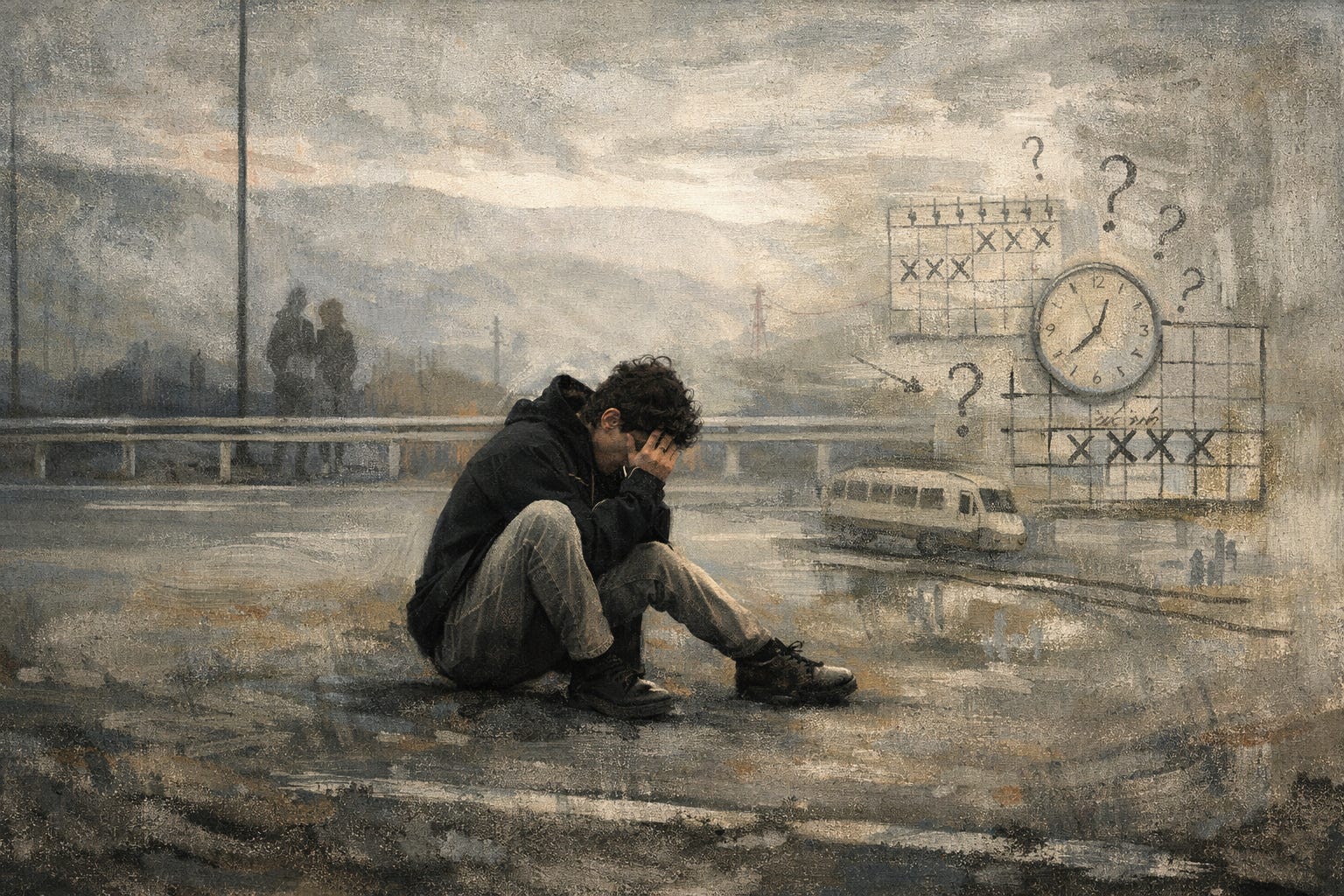
Sometimes I even pretend to have my act together when I don’t. Those moments kill me mentally. The pretend of control often comes in at work. In my personal life I completely let that part go and stress about the smallest things I don’t control. For example: my latest trip to Amsterdam with my girlfriend. I talked about this before in one of my writings but these things are really bad.
My girlfriend loves to go to Amsterdam, I’m not too big of a fan of it, but I’d go with her. Fine. We’d decide where to eat for lunch and dinner, but with no strict planning. She doesn’t mind, she’s fine with that - maybe even better. But my brain can’t handle that. I’m stressed about the fact whether we’ll make a train home 4 weeks before we even go. I don’t think that’s normal.
It must be a kind of Intolerance of uncertainty.
That’s what I’m trying to figure out. I want to know why my brain is doing this and how I can limit it or even stop it from happening. I wouldn’t call it a disorder yet, but maybe it is because that sense of control feels so natural, even when it isn’t. I shouldn’t have the need to control a train journey that’s 4 weeks in the future.
I want certainty that everything will be alright, I don’t care about that single train. I need reassurance.
The promise of control
Control equals certainty. At least, that’s the promise. If I can think things through far enough, prepare well enough, or anticipate enough variables in advance, then maybe nothing can really go wrong. Or at least I think that nothing can go wrong.
That’s what control gives me. When I’m responsible, I feel sharp and ahead of things.
Sometimes it even gives me validation, as if being the one who sees risks, plans ahead, and keeps everything together says something good about who I am.
But that’s the problem with control as well, It does not only solve problems. It also starts to feel like safety, identity, and self-worth. And when you do this every single day for years, it becomes very difficult to question. Because then letting go of control no longer feels like a practical adjustment. It feels like recklessness. Like lowering your standards. Like becoming less reliable, less competent, less useful.
That is the trap in it.
It looks like simple overthinking or perfectionism, but it’s a form of responsibility. As if not controlling things would mean failing to take life seriously and everything is going to fall apart. As if uncertainty itself is a sign that something has already gone wrong.
Control is a very clever thing. It reinforces itself. It gives an immediate reward and it tells you: “see, it worked”. Because having a plan calms me down, a backup plan calms me down even more. Thinking through every scenario creates the illusion that I am reducing risk, when often I am only reducing the feeling of risk.
That difference is important.
Because the more often I rely on control to regulate anxiety, the more I teach myself that uncertainty is something dangerous. Something to avoid and what begins as a coping mechanism slowly becomes a lifestyle.
And it would be only work-related, it could be okay (only if I could let it could at the end of the day) but t hat mindset does not stay connected to one part of life. It moves. It shows up in work and in personal life. In the need to know how a day will go before it begins. In the discomfort of open plans. In the urge to mentally prepare conversations, decisions, and trips. Even moments that are supposed to be relaxing.
But what frustrates me so much is that I can often see how irrational it is while still feeling unable to stop. I know that uncertainty is part of life. I know that not everything can be predicted. But knowing that intellectually is not the same as being able to get through it emotionally.
It’s that feeling of the absence of control. The possibility of getting something wrong, being seen as careless, or simply not being able to prevent disappointment. Control, then, is not just about managing the outside world. It is also a way of managing my own inside-world, I think.
That’s my way of keeping the anxiety at a distance.
The question is no longer just why I like control. It is why I need it so much and how do I limit it. The deeper problem is not that I value structure, responsibility, or preparation. Maybe the deeper problem is that I have tied those things too closely to my sense of safety.
I’ve wrapped myself up in safety nets.
When control stops being useful.
Control in itself isn’t bad. In a lot of situations it can help. It helps me to prepare for things and stay organized in a way I wouldn’t be if it wasn’t for organized Bryan. Nothing unhealthy in that. I kind of need that as well. It becomes an issue when control stops serving a practical function and starts serving an emotional one.
It’s no longer about doing something well, but about making sure I do not have to feel uncertain, exposed, or unsettled. You might not even see that you’re doing it.
Planning can still look like planning. Carefulness can still look like professionalism.
But deep down inside something has changed. It’s no longer for clarity. The goal becomes relief. I am not preparing because the situation truly demands it, but because I cannot fully relax until I have reduced every unknown I can find.
These are extreme situations that not happen all the time, but more often than I would want them to happen. And even then, the relief rarely lasts. One answer creates two new questions. One plan leads to the need for a backup plan. One attempt at certainty quickly becomes another.
That is usually the point where control starts becoming less of a strength and more of a dependency. So it’s not helping me anymore. It’s now become in charge of these situations instead of the assistent.
I can handle this, as long as I know what will happen. I can relax, as long as everything is planned.
I can trust the process.
But what if there’s no process, no plans, and no guarantees. Because life doesn’t guarantee anything. So the more I rely on control to feel okay, the more often I end up confronting situations that do not allow it.
That’s so energy-draining.
It can make simple decisions feel heavy because every option has to be thought through. Like just going for a walk.
No spontaneous things. That becomes stress. Especially when other people are more comfortable improvising, adapting, or leaving things open than I am.
But not when I’m alone. Then I can do whatever I want. The pressure seems to increase when uncertainty becomes shared, when plans depend not only on me, but on someone else’s expectations, pace, or unpredictability.
Maybe that is why control feels less necessary in solitude. Alone, uncertainty is only mine. With other people, it becomes something I have to endure without being fully able to control it.
Control and other people
Being in groups or with other people makes it clear. specially people who are more spontaneous than I am. People who are comfortable deciding later, adjusting on the go, or seeing what happens.
That kind of people, which probably feels like freedom to them, can feel like mental overload to me. That creates friction, not always outwardly, but internally. They would never know.
It is about the fact that I cannot fully steer it.
I have to share the uncertainty, and shared uncertainty feels heavier than the kind I carry alone.
When I am by myself, things often feel simpler. I can change my mind, adjust my pace, or make decisions without having to think about anyone else’s preferences or unpredictability.
That may also explain why situations that are meant to feel light can become mentally heavy. A trip, a day out, even an ordinary plan can start to feel like something I need to manage rather than simply experience.
What control is really protecting me from
If I strip it all away, the planning, the urge to think everything through, what is left is not order, but discomfort. Maybe even fear. Control helps me avoid that feeling. It gives me something to do with uncertainty.
That may be why it is so hard to let go of. Because what I call control is often not really about controlling reality. It is about not feeling helpless.
I do not always want control because I am dominant, rigid, or obsessed with order, it might look like that for others. Sometimes I want control because I am afraid of what happens in its absence.
The psychology behind it
It’s such a difficult thing to recognize. Because it rarely feels irrational in the moment. Control usually dressed up like responsibility, or discipline, a planning or just wanting to do a good job in general.
Psychologically, control is often doing more than organizing reality.
It is regulating emotion. More specifically, it can be a way of dealing with the discomfort that’s paired with uncertainty. Not knowing what will happen, how someone will respond, whether a decision will work out, whether something will go wrong.
Some people can sit with that uncertainty without needing to clear it straight away.
And others, like me, feel an almost automatic urge to close it as quickly as possible.
One possible explanation for this is generalized anxiety disorder, or GAD. Not because every need for control is a disorder but because GAD often includes excessive worry, difficulty controlling that worry, and a the tendency to anticipate problems before they happen.
In that context, control can become a way of staying ahead of anxiety.
That doesn’t mean it’s “just anxiety”, and it also doesn’t mean every structured person has GAD. But it does suggest that the need for control may sometimes be less about personality and more about what happens when uncertainty becomes emotionally difficult to carry.
But it also isn’t just wanting structure or perfectionism. It’s deeper than “preferring it”. It feels charged. It creates tension in the body and noise in the mind. The brain starts scanning for ways to reduce that tension, and control becomes one of the fastest available solutions.
Make a plan. Rehearse the conversation. Check again. Think it through one more time. Find the safest option.
Perfectionism can feed into this as well.
If getting something wrong feels like more than a small inconvenience, if it feels like evidence of carelessness, incompetence, or failure (also kind of imposter syndrome), then control becomes even more emotionally loaded.
It is also about protecting identity. Protecting the image of being capable.
That may be why this pattern tends to spread across different areas of life. Work and private life may look different on the surface, but the underlying thing can be the same.
Conclusion
I still don’t know exactly what to call this.
Maybe it is anxiety. Maybe perfectionism. Maybe intolerance of uncertainty. Maybe some mixture of all.
But I do know that what I often framed as responsibility has, at times, started to feel more like self-protection. Control has been my way of staying out of discomfort, and keeping uncertainty far away. At least as a feeling.
And maybe that is the real issue.
The difficult part is that control does work, at least for a moment. It calms me down. It gives me something to hold onto. But it also makes life smaller. It steals ease from ordinary moments and turns openness into something that feels dangerous.
I need to learn that uncertainty is not always something bad.
So maybe this is the real work in front of me. Not becoming a different person, and not abandoning structure entirely, but loosening the grip.
If control has become the thing I reach for to feel safe, then maybe the next step is not learning how to control better. Maybe it is learning how to need it less.
The universe on every level is trending towards disorder. We can do work locally within any defined system to minimise that or create a percieved order, but that always has the effect of increasing even further the state of disorder everywhere else. This is not going to be a helpful comment for you I feel, but generally, can we use the concept at a smaller scale to make ourselves freer? This is important as I think if we could accept the concept of disorder and lack of control as human beings with freedom of expression who are connected to the world, we would not be so afraid to act.